

Everything You Need to Know About Localizing Your Website for Global Growth

Most businesses with international ambitions already know they need a website in multiple languages. Fewer understand what that actually involves, and fewer still execute it in a way that generates real results in new markets.
Website localization is not the same as website translation. Translation converts your text from one language to another. Localization adapts your entire online presence, including URL structure, visual design, keyword strategy, cultural framing, and technical implementation, so that each market experiences a version of your site that feels built for them.
According to Entrepreneur, 75% of internet users do not make purchase decisions unless the product description is in a language they speak. Visual Capitalist estimates that 50% of the world’s population speaks just 23 languages, which means that a relatively small localization investment can open access to enormous audiences.
A professionally built multilingual website does more than expand your reach. It signals to international customers that you are a trusted global brand that pays attention to user experience, not just one that has run its content through a translation tool.
Below is a practical guide to building and localizing a website that works across markets.
Why Your Website Is Your Most Important International Asset

Regardless of your business size or sector, potential customers judge your professionalism by your website before they judge it by anything else. A poorly designed or single-language site signals to international visitors that they are not your intended audience, and they will act accordingly.
A well-built, localized site gives you a competitive edge that operates around the clock without advertising fees. When your international SEO strategy is working, your site appears in high-ranking positions for relevant searches in each target market without ongoing spend to maintain that visibility.
The SEO opportunity in non-English markets is also significantly less competitive than in English. In English, the keyword “make money” requires links from approximately 212 websites to rank in the top ten results. The Spanish equivalent, “ganar dinero,” requires links from around 30. That gap exists across most language pairs and represents a real commercial advantage for businesses willing to invest in multilingual content early.
Search dominance aside, a multilingual website builds deep-reaching trust with local, non-native English-speaking audiences in a way that a single-language site simply cannot. It also improves lead generation rates by removing the language friction that causes international visitors to leave without converting.
Understand Your Audience Before You Localize Anything

Consumer behavior varies significantly across countries, and assuming that international audiences interact with your brand the same way your home audience does is one of the most common and costly mistakes in international expansion.
An informal, conversational tone that resonates with US or UK audiences may read as unprofessional to German or Japanese buyers. Humor that works in one cultural context can fall flat or create the wrong impression in another. Content structured around the assumptions of your home market will feel foreign to readers from a different one, even when the translation is technically accurate.
Research your target markets before you begin localizing. Understand how buyers in each market make purchasing decisions, what trust signals matter to them, how they use search engines, and what communication style they expect from a brand in your sector.
For some markets, that research will also tell you whether your products or services are positioned correctly for local needs, which is something worth knowing before you invest in localization.
Choose the Right URL Structure for International SEO

Creating country-specific content starts with a structural decision that affects how search engines understand and rank your localized pages. You have three main options, and your choice should align with your objectives, budget, and the level of localization you plan to deliver.
Country code top-level domains (ccTLDs) are country-specific domain extensions such as .co.uk for the UK or .fr for France. They send a strong geotargeting signal to search engines and tend to build local trust quickly: a UK user is more likely to trust a .co.uk domain than a .com. They are the strongest option for businesses fully committed to specific national markets, but they require separate hosting infrastructure and independent SEO authority-building for each domain.
Subdomains use a prefix on your main domain, such as uk.yoursite.com or fr.yoursite.com. Search engines treat them as separate entities from the main domain, which means SEO authority does not transfer between them. They are a practical middle ground when you need geographic separation but want to operate from a single main domain.
Subdirectories keep localized content within your main domain structure, such as yoursite.com/uk/ or yoursite.com/fr/. They benefit from the domain authority of your main site, which makes them easier to rank for businesses that are not starting from scratch in each market. They are the most SEO-efficient option for most growing international businesses.
You can also combine approaches: a gTLD with subdirectories works well when you deal with both global and country-specific content simultaneously. Moz has a thorough breakdown of the pros and cons of each option if you want to go deeper on the technical tradeoffs.
Whichever structure you choose, implement hreflang tags for every localized page. Hreflang tells search engines which language or regional variant to display for users searching in a specific language or location. Without them, search engines may serve the wrong language version to the wrong audience, hurting both rankings and user experience. In multilingual countries where a subdomain or subdirectory geotargets a country but not a specific language group, hreflang tags are the mechanism that fills that gap.
Get the Translation Right

Machine translation has improved considerably, but it is not sufficient for public-facing website content where conversion and brand reputation are at stake.
The core problem is context. Automated tools frequently distort meaning in ways that native speakers detect immediately: unnatural phrasing, incorrect register, idioms that do not transfer, and terminology that is technically correct but culturally wrong. The result is lower conversion rates and reputational damage that is difficult to recover once it has set in.
Human translators do more than convert text. They adapt tone, style, and cultural framing to match the expectations of each target audience. For professional website translation, working with an experienced agency or specialist freelancer is an investment that pays back through higher engagement and conversion in each new market.
Prioritize your highest-impact pages first. Sales pages, product descriptions, and landing pages are your primary customer acquisition assets and should receive the highest translation quality. Blog content and secondary pages can follow as resources allow.
Neil Patel’s multilingual strategy illustrates this well. His sales pages are professionally translated into nine languages, while his blog is only available in five. Translating sales pages is a one-time cost with ongoing returns. Maintaining a multilingual blog requires continuous content investment, so matching your scope to your resources is the right approach.
Localize Your Keyword Strategy for Each Market
Translating your existing keywords word-for-word into another language will not produce the same search performance. Keywords reflect how people in a specific language and cultural context describe what they are looking for, and that phrasing often differs significantly from a direct translation.
The word “accommodation” in English, for example, translates into terms across European languages that carry different levels of search volume and different search intent. Using the wrong term means targeting the wrong audience or missing search demand entirely.
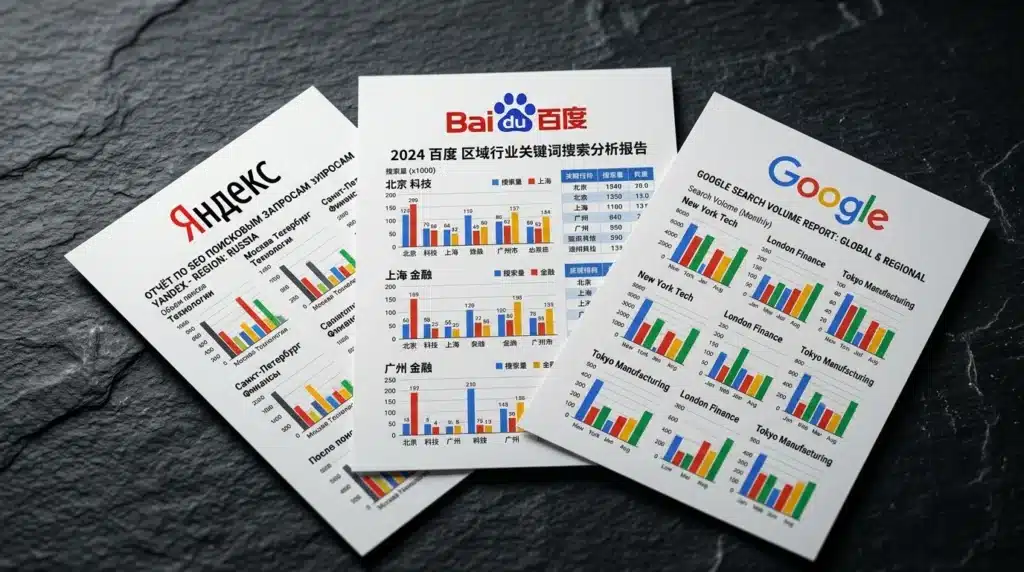
Conduct fresh keyword research for each target market rather than adapting your existing keyword list. Tools that support multilingual keyword data will show you actual search volumes and competition levels for terms in each language. Pay attention to regional search engine preferences too: Google dominates most markets, but China uses Baidu and Russia uses Yandex, and ranking strategies differ between platforms. Seeking local SEO expertise for each target market is a sound investment, particularly when entering markets where search behavior differs significantly from your home market.
For a deeper framework on this, our guide to keyword research in unfamiliar languages covers the methodology in detail.
Adapt Your Design for Each Culture

Visual and structural design choices that feel natural to your home audience can create friction or offense for users from a different cultural background.
Layout direction is the most structurally significant issue. Most users read in an F-shaped pattern, scanning left to right with attention concentrated on the left side of the page. Arabic-speaking users read right to left, which inverts those attention patterns. A layout optimized for left-to-right reading will not convert well for Arabic-speaking audiences without being mirrored.
Color carries cultural meaning that varies considerably across markets. In Western markets, blue signals trust and security. In parts of Asia where Hinduism is dominant, blue carries associations of immorality. Red signals danger or error in most Western UI contexts but represents luck and prosperity in Chinese digital culture. Study the meaning of colors across different cultures before finalizing your design for each market.
Photography and imagery need localization too. A photograph that feels neutral or aspirational in a North American context can read as culturally inappropriate in another market. An image of a woman in shorts that works in a US campaign may be considered offensive in an Arabic-speaking market. Visuals should reflect the cultural context of the audience seeing them, not the context of the team producing them.
For markets where your team does not have in-house cultural knowledge, consult a design agency based in the target region. If you are based in Europe and expanding to the US, for example, working with a design agency in New York gives you local market perspective that remote adaptation cannot fully replicate. Text expansion also affects design: English is one of the more compact languages, and translations into French, German, or Spanish typically increase string lengths by 20 to 40 percent. Layouts need to accommodate that expansion without breaking.
Five Multilingual Websites Worth Learning From

Looking at how major brands have approached multilingual websites reveals practical decisions you can apply regardless of your scale.
Nike uses IP geolocation to direct users to the correct country subdirectory automatically, while keeping a visible language and location selector at the bottom of every page. The selector matters: visitors who are traveling or who prefer a different regional version need a manual override, and hiding that option creates frustration. Nike supports more than 40 languages including Spanish, Portuguese, Japanese, Mandarin, Thai, and French, with localization applied to each version rather than just translation.
KFC structures its URLs to signal country targeting clearly, and integrates its online and offline operations by market. When you access KFC Japan’s contact channels, you reach KFC Japan staff, not a central global team. The contact options also reflect local communication preferences: KFC Japan includes a Line option, which is the dominant messaging platform in that market. Matching contact channels to regional communication habits is a detail most brands overlook.
IKEA does not automatically default users to a language based on geolocation. Instead, it presents regional options based on proximity and lets the user choose. A user in the Philippines sees options for ikea.ph alongside ikea.com/tw, ikea.cn, ikea.jp, ikea.kr, and ikea.com/hk. Not assuming language preference for users in multilingual regions is a more respectful and more accurate approach than forced redirection.
Lego Ventures keeps its language selection to two: English and Chinese. The choice reflects where the bulk of their audience is concentrated rather than an attempt to cover every possible market. Not every business needs to localize into every language its audience uses. Prioritize the languages where the return is clearest and expand from there.
Neil Patel translates his sales pages into nine languages and his blog into five. For most businesses, this sequencing is correct: sales pages first, content second. A multilingual blog requires ongoing investment in content creation and promotion in each language. Limiting blog localization to your most important markets while keeping sales pages fully localized across all targets is a practical way to manage scope. For more on the technical and strategic foundations, see our guide to best practices for building a multilingual website.
Test Before You Launch

Every localized website needs two rounds of testing before it goes live: localization testing and linguistic testing.
Localization testing covers the technical layer. Check loading times, hardware compatibility, hyperlink integrity, form functionality, and whether measurement units, date formats, and currency displays are correct for each target market. Layouts that work in English may break when text expands in translation. Date formats that read clearly to a US audience create ambiguity in European markets where day and month positions are reversed.
Linguistic testing verifies that the translated content is accurate, natural, and appropriate. Look for spelling errors, grammatical mistakes, keyword misuse, inappropriate register, and readability issues. A technically correct translation that reads awkwardly in the target language will still underperform. Native speaker review is the standard for this stage, not a final automated spell check.
For technical content in particular, both layers of testing are necessary because errors in technical documentation carry risk beyond poor user experience.
For the e-commerce context specifically, test the full purchase path in each language: navigation, product descriptions, checkout flow, confirmation emails, and error messages. These are the moments when translation quality most directly affects conversion and return rates.
Define Your Scope, Then Start

The most practical first step is to look at where your existing visitors and customers already come from. The languages represented in your current traffic are the markets most likely to respond to localization investment, because demand for your product already exists there.
From that starting point, define what you want to localize: your core sales pages, your full site, your blog, or a combination. Decide on your URL structure, brief your translators with full context rather than just source text, conduct market-specific keyword research, and build localization requirements into your design from the beginning rather than retrofitting them after launch.
A well-executed website localization strategy consistently outperforms a single-language global site on every metric that matters: organic search visibility, conversion rate, customer trust, and long-term revenue in each target market.
Ready to Localize Your Website for International Markets?

BeTranslated provides professional website translation and localization for businesses expanding into European and global markets, with specialist translators across a wide range of language pairs and sectors.
📞 +34 962 02 22 22
Frequently Asked Questions
What is the difference between website translation and website localization?
Website translation converts your text from one language to another. Website localization adapts the full site experience for each target market, including URL structure, visual design, cultural references, color choices, date and currency formats, keyword strategy, and layout direction. A translated site that has not been localized will often underperform in new markets even when the language is technically correct, because the surrounding experience still feels built for a different audience.
Which URL structure is best for a multilingual website?
It depends on your objectives and resources. ccTLDs (such as .co.uk or .fr) send the strongest geotargeting signal and build local trust quickly, but require separate infrastructure and independent SEO work for each domain. Subdirectories (yoursite.com/fr/) are the most SEO-efficient option for most growing businesses because localized pages benefit from your main domain’s authority. Subdomains are a middle ground. Many businesses combine a gTLD main domain with subdirectories for country-specific content. Whichever structure you use, implement hreflang tags to ensure search engines serve the correct language version to the correct audience.
How do I do keyword research for languages I do not speak?
Start with multilingual keyword tools that show search volume and competition data in your target language rather than translating your existing keywords directly. Work with a native-speaking SEO specialist or translator who understands how people in that market describe what they are searching for. Remember that search engine preference also varies by country: Google dominates most markets, but China uses Baidu and Russia uses Yandex, and keyword strategies need to be adapted accordingly. Our dedicated guide to keyword research in unfamiliar languages covers the methodology in more detail.
Do I need to localize my entire website at once?
No, and for most businesses, starting with your highest-impact pages is the right approach. Sales pages, product descriptions, and primary landing pages generate the most conversion value and should be localized first. Blog content and secondary pages can follow as resources allow. Prioritize languages where you already have measurable audience interest before expanding to additional markets.
How do I know if my website localization is working?
Track organic search visibility, traffic, and conversion rates separately for each localized version of your site. If a localized version is receiving traffic but converting at a lower rate than your main site, the issue is likely in the translation quality, cultural adaptation, or purchase path experience rather than the URL structure or keyword strategy. Run both localization testing and linguistic testing before launch, and continue monitoring market-specific performance data after launch to identify where further optimization is needed.