
Think about the last time you landed on a website in a language you didn’t speak. You probably left within seconds. Your international customers do the same thing, every single day. That’s the silent cost of skipping website localization, and why Website localization solutions matter more than ever.
The good news? Automating the process is more accessible than most businesses realize. With the right CMS connectors and APIs, you can turn localization from a quarterly headache into a seamless, continuous workflow using modern Website localization solutions. Here’s how.
76% of global consumers prefer buying products with information in their native language, spanning online shoppers across Europe, Asia, North America, and South America.
Source: csa-research.com
Why Manual Localization Holds Your Business Back
Content moves fast. Whether you run an e-commerce store, a SaaS platform, or a corporate blog, new pages, product descriptions, and blog posts go live constantly. Manually extracting, translating, and re-inserting that content into your CMS is not only slow, it’s expensive.
Industries that feel this pressure most acutely include :
- E-commerce : product catalogs updated daily in English, French, Spanish, German, and Dutch
- IT and software : release notes, UI strings, and documentation that never stop evolving
- Legal services : compliance content that must be precisely localized for each jurisdiction
- Travel and tourism : destination content serving Chinese, Japanese, Arabic, and European markets simultaneously
- Marketing agencies : multilingual campaigns that need to launch in sync across regions
Automated localization solutions remove the friction from every step in this chain and are a core part of effective Website localization solutions.
What CMS Connectors and APIs Actually Do for Website Localization Solutions
Let’s be honest, “connectors” and “APIs” can sound intimidating if you’re not technical. But the concept is surprisingly straightforward.
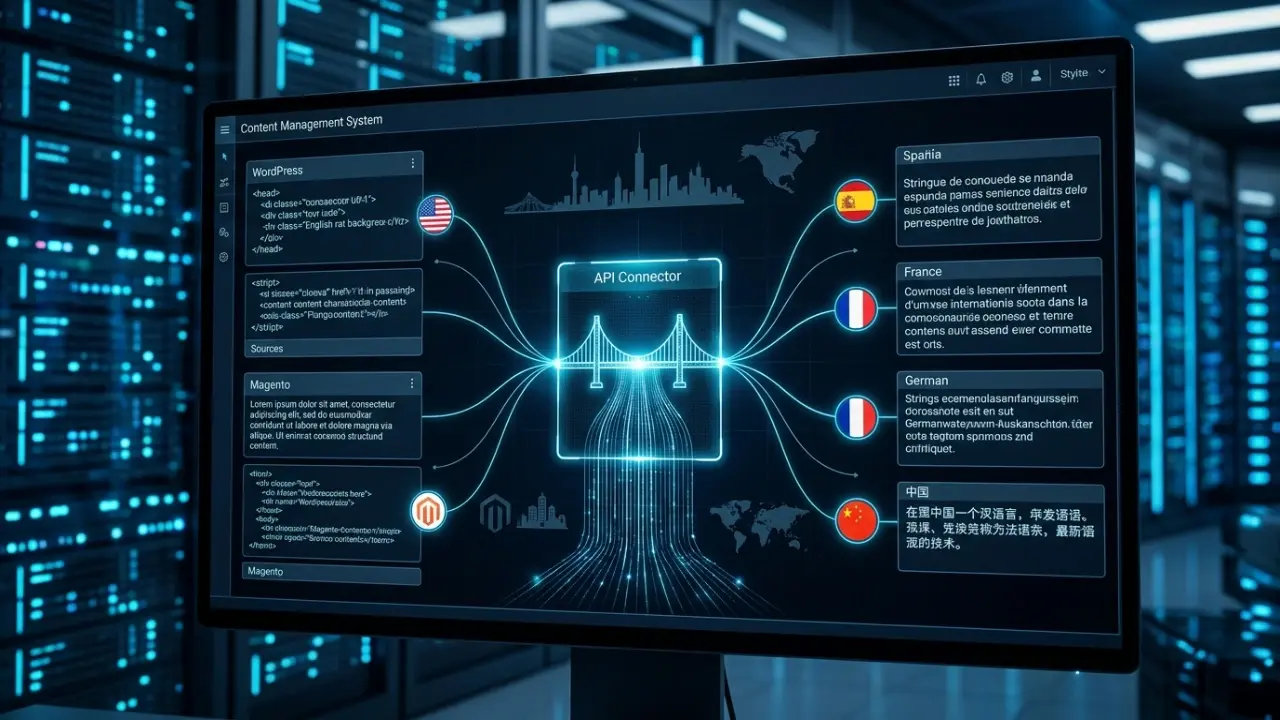
A CMS connector is essentially a bridge. It links your content management system, WordPress, Drupal, Magento, or others, directly to a translation service provider’s platform. When you publish or update content, the connector automatically sends it for translation. No copy-pasting. No email threads. No delays.
An API (Application Programming Interface) works similarly but is more flexible. It’s particularly useful when your CMS is custom-built and doesn’t support off-the-shelf connectors. A developer can build an API integration tailored exactly to your platform’s architecture.
Both approaches feed content into CAT tools (Computer Aided Translation tools) such as Trados, Phrase, or Smartcat, where professional linguists complete the website translation with full context and consistency.
CMS Platforms We Work with At BeTranslated
As a translation agency that specializes in IT translation, BeTranslated keeps up with the platforms businesses actually use. Through tools like Smartcat, we support connectivity with a broad range of systems :
- WordPress : the world’s most widely used CMS, compatible with the WPML plugin for real-time multilingual publishing
- Magento : a leading cloud e-commerce platform used by retailers from Madrid to Tokyo
- Drupal : a powerful, enterprise-grade CMS used by enterprise and public-sector organizations
- Bitrix : popular in Russian-speaking markets and CIS countries
- Git / GitHub / GitLab : for development teams managing versioned content repositories
- Mercurial and SVN : open-source version control systems for technical projects
- Dropbox, OneDrive, SharePoint : for teams sharing documents in cloud storage folders
- Zapier : for connecting virtually any platform through general automation workflows
WordPress is used by 59.8% of all websites whose CMS is known, and it represents 42.5% of all websites.
Source: W3Techs
Custom CMS? That’s where a purpose-built API comes in. Depending on the complexity, a developer can typically build a working connector in around six weeks, and the Smartcat team can recommend vetted development partners if needed.
We update these integrations regularly as new connectors become available.
The Real Benefits of Automated Localization
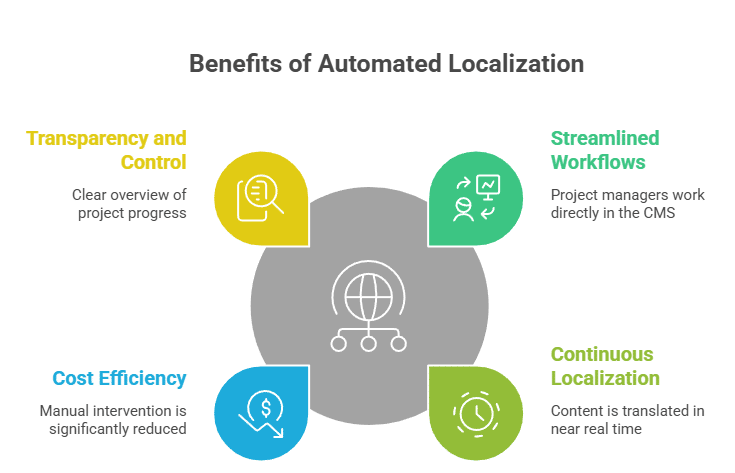
Streamlined workflows, your project managers work directly inside your CMS environment. Content flows to our linguists automatically, and translated files come back the same way. No bottlenecks, no version confusion.
Continuous localization, rather than batching content for translation every few months, your multilingual website stays in sync with your source language in near real time. The moment you publish in English, our team is notified and can begin translating into Spanish, French, German, Chinese, Japanese, or any other target language.
One case showed 6X higher international conversion rates and 70% more website visits after multilingual implementation.
Source: webinarcare.com
Cost efficiency, once the integration is set up, the need for manual intervention drops significantly. You’re not paying for repeated file handling, reformatting, or human coordination steps that add no linguistic value.
Transparency and control, centralizing translation within your digital platform gives you a clear overview of every project’s progress, from first word to final publish.
We also give you access to a network of more than 5,000 language experts covering over 175 languages, including less-served languages like Estonian, Arabic, Vietnamese, and Ukrainian.
What About SEO Across Languages?
This is where many businesses stumble. Translating your content is only half the picture. A truly localized website also needs its SEO strategy adapted for each target market.
Search behavior differs by language and region. A user in Brazil searching in Portuguese doesn’t use the same keywords as a Spanish speaker in Mexico. A buyer in Japan searching in Japanese follows entirely different patterns than one in South Korea using Korean.
Websites using SEO localization see 70% increases in organic traffic within 12 months.
Source: shno.co
Our SEO translation service addresses this, adapting not just the words but the search intent, keyword density, metadata, and URL structures for each locale.
Working with BeTranslated : A Tailored Approach
BeTranslated is a premium translation agency, which means you won’t get a one-size-fits-all solution. Every project starts with a conversation about your CMS, your content volume, your target markets, and your budget.
We only work with native speakers. That matters more than it might seem. A native French speaker catches nuances that a fluent-but-non-native translator might miss. The same applies whether we’re localizing from English into Italian, from Spanish into Chinese, or from French into Dutch.
Multilingual sites with translated product descriptions achieve 55% higher conversions than English-only versions.
Source: shno.co
Our project managers handle the technical coordination, so you don’t have to chase translators, manage files, or worry about missed updates. You focus on your content. We handle the rest.
Curious about timelines or rates? You can check our turnaround times and translation rates online, or contact us directly for a tailored estimate.
Ready to Stop Translating Manually and Start Scaling Globally with Website Localization Solutions ?
Your next customer might speak Mandarin, Arabic, or Dutch. Let BeTranslated build the localization pipeline that reaches them, automatically, accurately, and without disrupting your team through powerful Website localization solutions.
Request a free quote today and let’s map out the right connector solution for your CMS.