6 Ways to Identify Market Opportunities for Business Growth
To stand out from the competition, your company needs to develop skills to identify market opportunities that will help your business to grow. While there are numerous opportunities out there, not all are worth investing in.


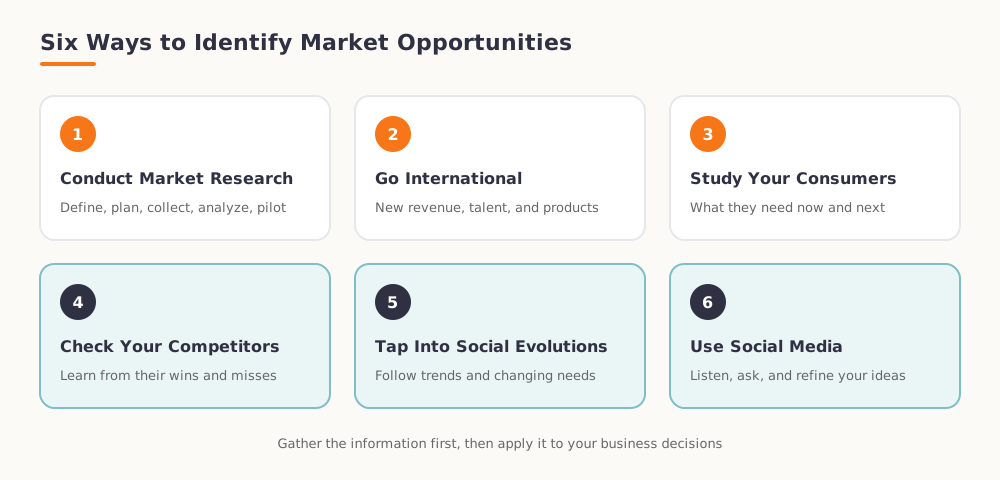
Six Ways to Spot New Market Opportunities
To stand out from the competition, your company needs the skills to identify market opportunities that will help your business grow. There are numerous opportunities out there, but not all are worth investing in.
"Chasing too many growth initiatives can be dangerous for your business."Source: MarketResearch.com, 5 Keys to Conducting a Market Opportunity Analysis, 2018
To avoid overwhelming your team with the wrong venture, take time to assess your strategy and set up a framework for evaluating opportunities. Start with your company’s vision and decide whether your team can take on new ventures and expand its operations. Once you know your organization’s strengths and limitations, you are ready to search for the best opportunities.
The aim is to find opportunities that show promise and will impact your business’s growth. Let’s break it down into six steps.
Conduct Thorough Market Research
While not a groundbreaking idea, conducting market research is a straightforward way to learn about your market and give direction to your advertising strategy.
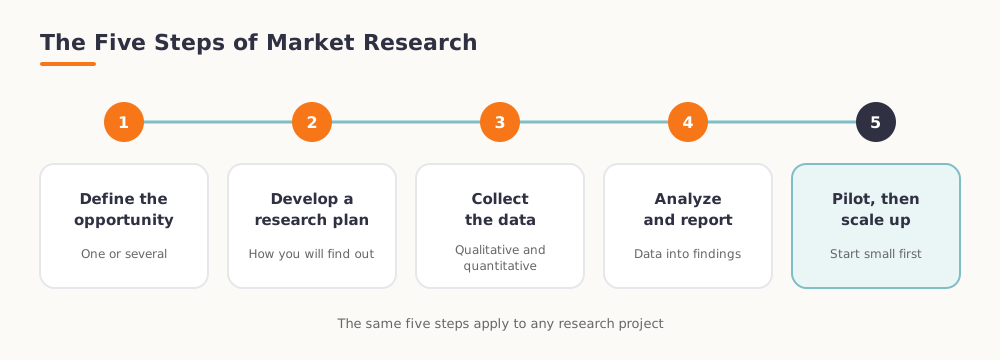
The process is similar to that of any research project and involves five principal steps:
- Defining the opportunity(s)
- Developing a possible marketing research plan
- Data collection (qualitative and quantitative data)
- Analysis of accrued data and reporting
- Piloting the opportunity, then scaling it up
Check Out International Markets
Business growth may also mean that you explore international markets. From business maturity to home-market saturation, there are many reasons why your company may be considering expansion into foreign markets. The advantages of going global include:
- New investment opportunities
- More revenue
- New talent acquisition
- Product diversification
Before deciding which countries you’d like to branch out into, you need to research their economy and your legal responsibilities.
When you take your business overseas, you may need to hire more staff. Getting the right kind of talent is a concern for any entrepreneur, but there are resources out there that can help.
In Singapore, for example, you can hire through an employer of record (EOR) such as Remote People, formerly Horizons, which acts as the legal employer while you manage the daily work.
"An EOR is a very convenient method for companies looking to hire a small team without setting up a subsidiary in the country."Source: RemotePeople, Employer of Record (EOR) in Singapore, 2026
You may also need to hire a professional translation service provider so that you can communicate clearly with your new business partners and customer base.

Study Your Consumers
You should study your current customers to find out what other services or products they may benefit from. This knowledge may inform which products or services you offer in the future.
You may wish to expand to other services that your customers currently need or those that they will need in the future so that you can keep your customers, even as their lives change.
For instance, if your company manufactures and distributes baby food, you ought to find out what other products you can introduce that parents and carers of these infants will be interested in as their kids get older, such as snacks for children’s lunchboxes.
You should strive to collect information such as client characteristics ranging from age, education status, and income to attitude and lifestyle. These variables influence customers’ purchasing decisions, preferences, and power.
Check Out Your Competitors
Being up to speed on what your competitors are doing is just as important as understanding your customers. You can learn a great deal from evaluating the successes and failures of other businesses on the market.
This is particularly useful if your company plans to diversify or launch a new product or service. Are other companies offering a similar service? What is successful about it, and what could be improved?
Take this knowledge and use it to give your business a leg up.
Tap Into Social Evolutions
Although your customers may be very loyal to your brand, they won’t think twice about moving to one of your competitors as their needs change. It’s important, therefore, to stay on top of how consumers shift their purchasing patterns.
This information will provide you with the strategies to evolve to meet your customers’ needs. You should be informed about general changes in society, new trends, and how they could impact those needs.
A great example of this is our new awareness of and concern about the environment. These days consumers want to know what businesses are doing to reduce their carbon footprint, and some prefer companies that take measures such as using recycled packaging.
Keep up with these changes, and your business will be better placed to grow.
Use Social Media
We cannot overstate the value of social media for business marketing. Not only should you be using various social media platforms to advertise your products and services and target your ideal customer, but you can also mine them for information about that customer.
Social media trends and discussions show you what the public really thinks about your services, as well as those of your competitors. You can also engage directly with your customers by running fun surveys and polls about new or existing products, and get unedited opinions straight from the horse’s mouth.
This kind of input can help you refine your ideas. In a nutshell, this strategy is one of the best ways to identify market opportunities for your business growth.
Social channels are great for engagement, but expanding your reach often requires a more direct approach to traffic generation. Many businesses find that relying only on social networks limits their visibility to specific user demographics.
To scale effectively, it helps to diversify your campaigns across different networks and ad formats. Finding the best advertising platform for your specific niche can change how quickly you acquire new customers, because a diversified approach helps you reach real users who are already interested in your products.
Turning Research Into Decisions
As our six tips have shown, gathering information is the first step toward embracing opportunities for business growth. The real work is what you do with that knowledge.
Take everything you’ve learned and apply it to your business decisions. Do that, and you will be better placed to choose the opportunities worth your investment.
Once your company is ready to branch into international markets, we can help with your translation needs in 50+ languages, from translating marketing material aimed at your new customers to translating the relevant legal documentation.
For more information or a free, no-obligation quote, get in touch today.